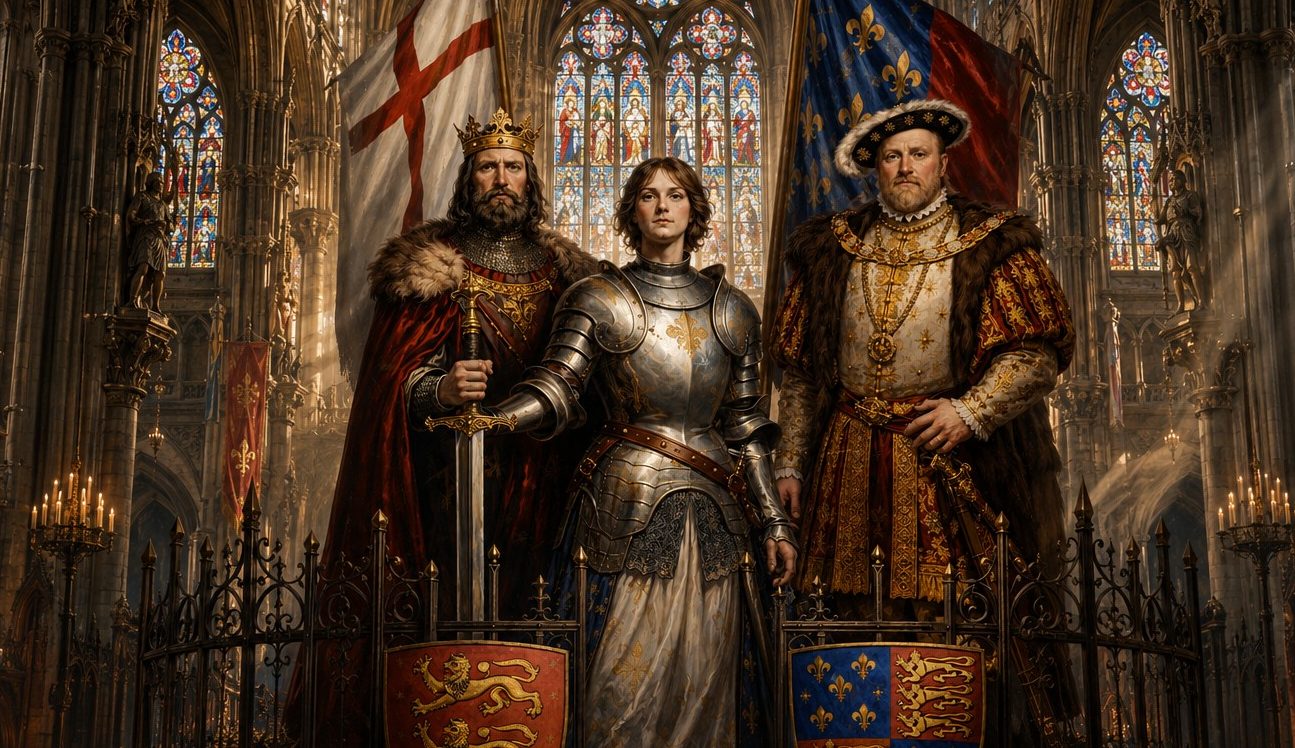

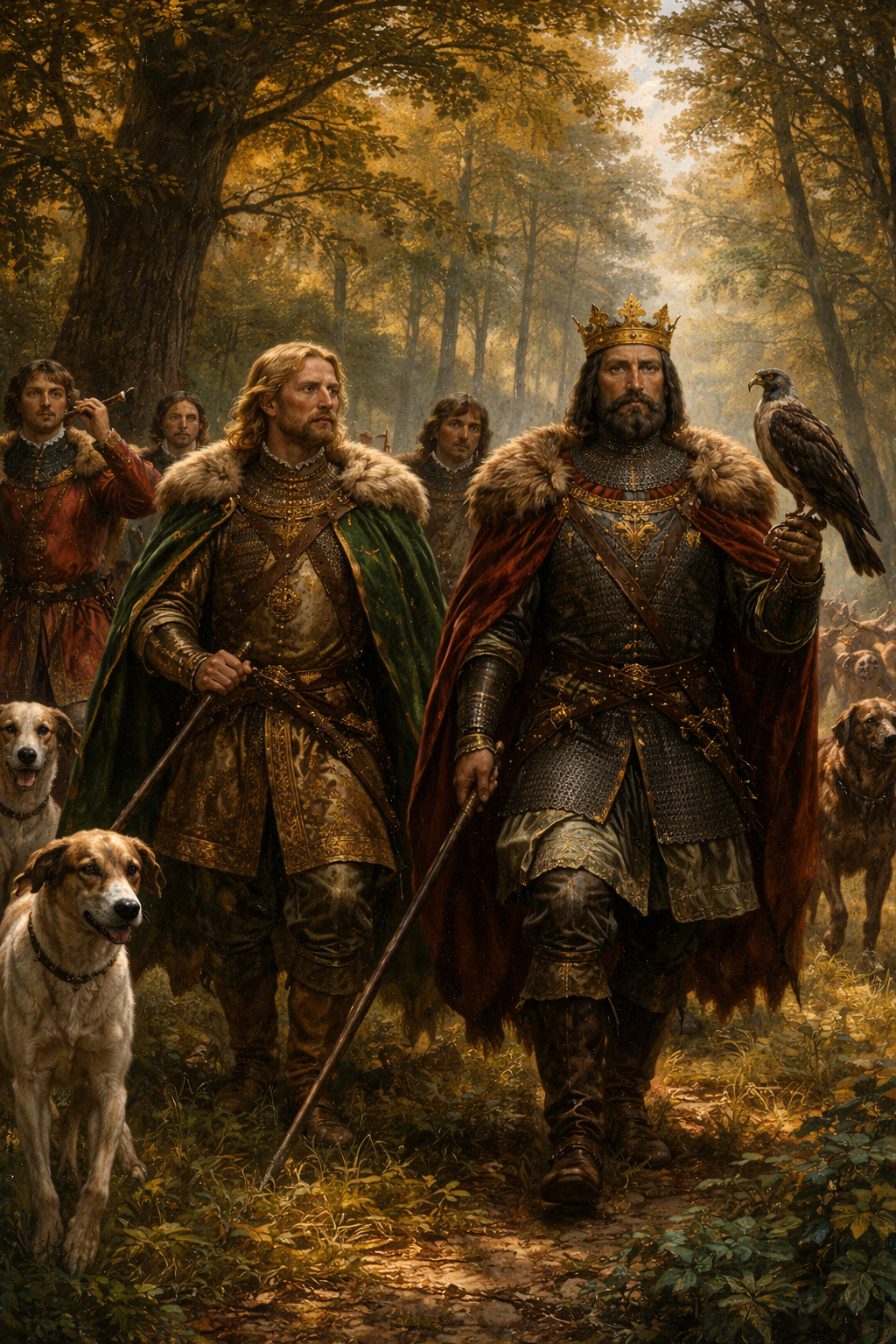
The relationship between the Frankish kings and the Viking leader Rollo is one of the defining moments in the creation of medieval Normandy. It was born not out of friendship, but exhaustion, warfare, and political necessity.
By the late 9th and early 10th centuries, Viking raids had devastated large parts of the Frankish kingdoms. Rivers were the highways of Europe, and the Vikings mastered them. Longships could sail from the sea deep inland along the Seine River, the Loire River, and others, allowing raids on wealthy monasteries and cities. Paris itself had been besieged repeatedly.
The Frankish king at the centre of this story was Charles the Simple. The Viking leader was Rollo, sometimes identified in Norse tradition as Hrólfr. Rollo had become too powerful to simply eliminate. Instead, the king chose negotiation.
The Treaty and the Oath
In 911, after further Viking pressure around the lower Seine valley, Charles and Rollo reached what is usually called the Treaty of Saint-Clair-sur-Epte.
The arrangement was simple in theory:
- Rollo would receive lands around Rouen and the lower Seine.
- He would defend the river and coastline against other Viking raiders.
- He would convert to Christianity.
- He would become a vassal of the Frankish king.
This was essentially a feudal contract. Land in exchange for loyalty and military protection.
The symbolic moment often remembered is the oath ceremony. Medieval chroniclers describe how Rollo was expected to kneel and kiss the king’s foot in submission. Supposedly, he refused to kneel himself and instead ordered one of his warriors to perform the act. The warrior reportedly lifted the king’s foot so high that Charles toppled backward — an image medieval writers loved because it captured the uneasy nature of the agreement. Whether literal or embellished, it symbolised that the Vikings were not truly subdued.
“From the River to the Sea”
The phrase in this context refers quite literally to geography and power.
The grant to Rollo centred on the Seine corridor — from the river inland to the sea coast. Whoever controlled that stretch controlled access into northern France. The Vikings understood that rivers were strategic arteries.
But the agreement also created a frontier society. The original territory granted to Rollo was relatively modest compared with later Normandy. Over time, the Norman rulers expanded westward and southward, absorbing neighbouring territories. What began as a buffer zone became a growing principality.
The Frankish kings expected:
- defence,
- stability,
- and containment.
Instead, the Normans evolved into one of the most aggressive expansionist powers in Europe.
Breaking the Spirit of the Oath
Technically, the Norman dukes remained vassals of the French crown for generations. But in practice, they increasingly behaved as independent rulers.
The “contract” with the king was transformed over time:
- The Vikings adopted Christianity.
- They learned the French language.
- They married into Frankish nobility.
- They stopped being seen as “Northmen” and became “Normans.”
Yet they retained the Viking appetite for conquest, mobility, and military innovation.
Rather than merely guarding the Seine, the Normans expanded their influence:
- across western France,
- into England,
- into southern Italy,
- Sicily,
- and even into the Crusader states.
The clearest example came in 1066 when William the Conqueror, Duke of Normandy, invaded England in the Norman Conquest.
At that point, Normandy was no longer a defensive frontier granted by a weak king. It had become the core of a transnational military state.
The Irony of Normandy
There is a deep irony in the story.
The Frankish crown created Normandy to stop Viking invasions.
Instead:
- it legitimised Viking settlement,
- gave them fertile land and political legitimacy,
- and allowed them to evolve into one of medieval Europe’s most formidable aristocracies.
The Vikings did not remain outsiders forever. They became French-speaking Christian nobles — but with a warrior culture still shaped by their Scandinavian roots.
In many ways, Normandy represents the fusion of:
- Norse ambition,
- Frankish feudalism,
- Christian legitimacy,
- and maritime military culture.
The oath between king and Viking was therefore not merely a peace treaty. It was the birth of a new political identity — one that eventually reshaped much of medieval Europe.