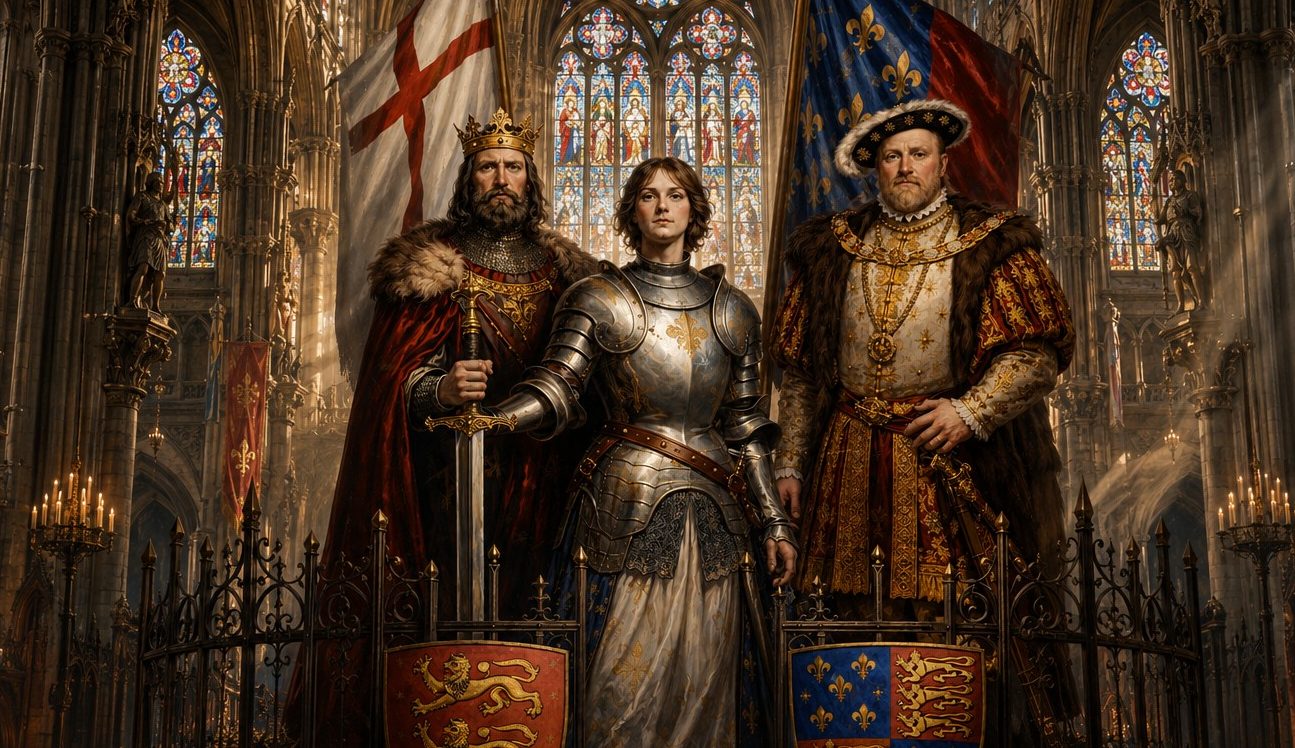

The end of the Hundred Years’ War did not simply mark a military defeat for England — it shattered an entire political world. For over a century, English kings had claimed vast territories in France and, at times, even the French crown itself. The loss of those ambitions created economic crisis, political bitterness, social instability, and ultimately civil war inside England itself.
The collapse abroad became the seed of collapse at home.
The Final Collapse of English France
At the beginning of the 15th century, England appeared unstoppable.
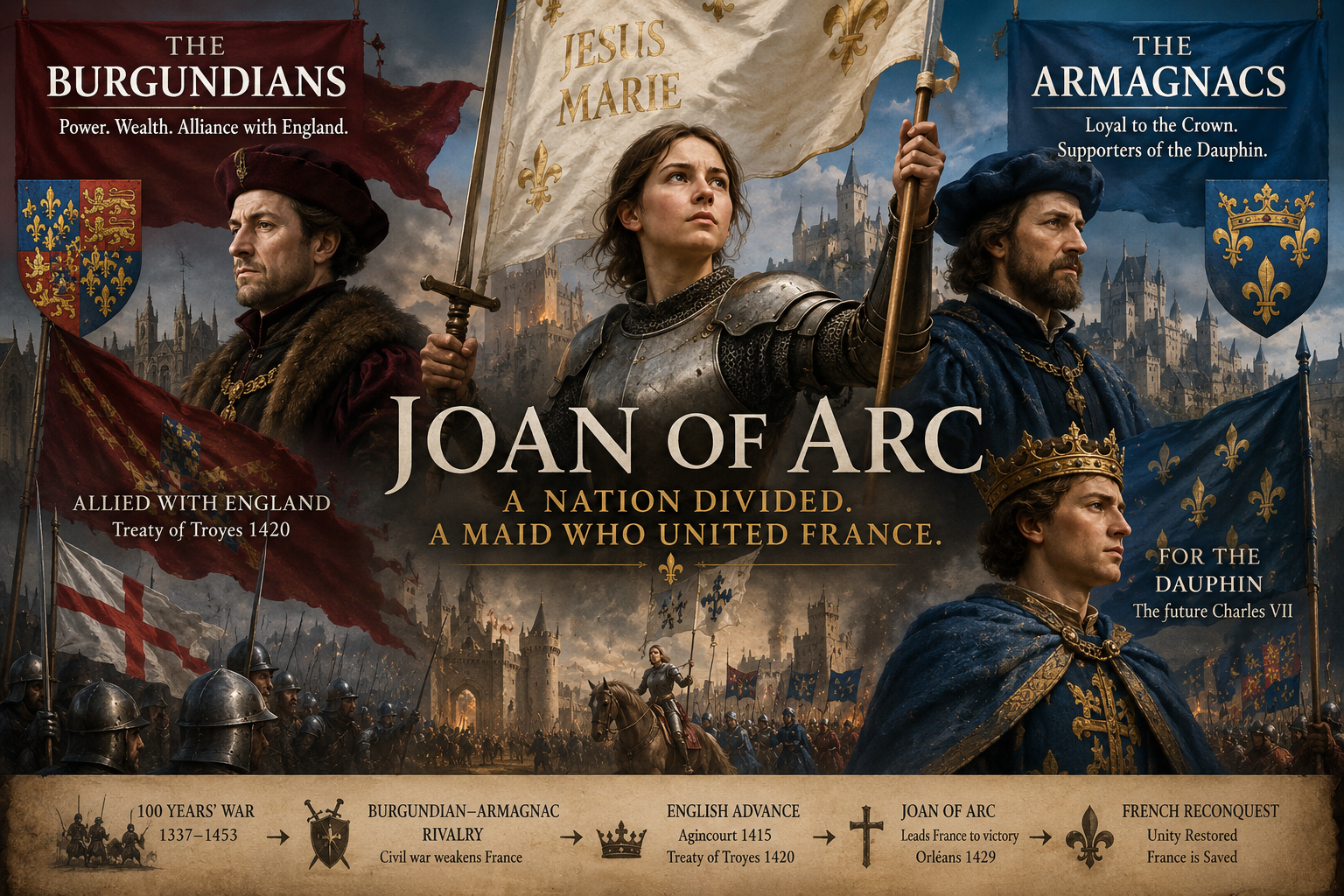
Under Henry V, England won stunning victories such as the Battle of Agincourt and conquered huge parts of northern France. Through the Treaty of Troyes, Henry V was even recognised as heir to the French throne.
France itself was divided between the rival factions of the:
- Burgundians
- Armagnacs
The John the Fearless and later Philip the Good allied with England because they hated the Armagnac faction more than they hated foreign occupation.
For a brief moment, it looked as though England might truly absorb France.
But everything changed after the deaths of both Henry V and the French king Charles VI in 1422.
England was suddenly ruled by an infant:
Henry VI.
Meanwhile France slowly rallied around the disinherited Dauphin:
Charles VII.
Joan of Arc and the French Revival
Into this chaos came:
Joan of Arc.
She transformed the war psychologically more than militarily.
Before Joan, many French nobles believed defeat was inevitable. The English seemed favoured by God. France was fractured, exhausted, and humiliated.
Joan reversed that mood completely.
Her arrival lifted the siege of Orléans in 1429 and helped escort Charles VII to his coronation at Reims Cathedral — an enormously symbolic moment because French kings traditionally had to be crowned there to appear legitimate.
The war changed from:
- a feudal dispute between dynasties
into:
- a growing struggle of French national identity against foreign occupation.
England never fully recovered from that shift.
Burgundy Abandons England
The single greatest strategic disaster for England came in 1435.
The Burgundians switched sides.
Through the Treaty of Arras, Burgundy reconciled with Charles VII.
England suddenly lost:
- its strongest ally
- access to key territories
- diplomatic legitimacy inside France
After this point, the English position steadily collapsed.
France also modernised militarily:
- stronger taxation
- permanent royal armies
- effective artillery
England still relied heavily on feudal levies and expensive overseas campaigning.
One by one the English territories fell.
By 1453, after the Battle of Castillon, England lost almost all its French possessions except Calais.
The Hundred Years’ War was effectively over.
England Turns Inward
The defeat was catastrophic psychologically.
For generations, English kings and nobles had built their prestige, wealth, and careers around France.
Suddenly:
- thousands of soldiers returned home unemployed
- nobles lost lands and revenues
- taxation had achieved little
- the monarchy looked weak and incompetent
Worse still, King Henry VI was utterly unsuited to crisis.
Unlike his warrior father Henry V, Henry VI was deeply pious, passive, indecisive, and vulnerable to mental collapse. He struggled to control powerful rival nobles who increasingly formed armed factions around themselves.
England now faced:
- economic strain
- aristocratic feuds
- weak monarchy
- military humiliation
- regional disorder
The country began withdrawing psychologically from grand European conquest and turned inward toward its own divisions.
The Seeds of the Wars of the Roses
The English nobility had spent generations fighting abroad in France.
Now those battle-hardened magnates turned their rivalries against each other at home.
The two great rival branches of the Plantagenet dynasty emerged:
- House of Lancaster
- House of York
Both claimed descent from Edward III.
The Lancastrians supported Henry VI.
The Yorkists rallied around:
Richard, Duke of York.
The struggle became known as:
Wars of the Roses.
The red rose symbolised Lancaster.
The white rose symbolised York.
Why France’s Loss Helped Cause Civil War
The Hundred Years’ War had previously acted as a release valve for English aggression.
French campaigns gave nobles:
- land
- wealth
- glory
- employment
- unity under the crown
Once France was lost:
- noble rivalries intensified
- private armies grew
- the monarchy weakened
- legitimacy collapsed
The war abroad became war at home.
Many historians see the Wars of the Roses as the direct political aftershock of losing France.
The Rise of the House of Tudor
The civil wars devastated the old Plantagenet aristocracy.
Kings were overthrown.
Princes disappeared.
Nobles were executed in waves.
Major turning points included:
- Battle of Towton
- Battle of Barnet
- Battle of Tewkesbury
Eventually the Yorkist king:
Richard III
seized the throne.
But his reign ended dramatically at the:
Battle of Bosworth Field.
There he was defeated by:
Henry VII.
Henry Tudor’s claim to the throne was relatively weak by blood, but he won by force, alliance-building, and exhaustion with decades of chaos.
He married:
Elizabeth of York,
uniting Lancaster and York symbolically.
This founded:
- the House of Tudor
and effectively ended the medieval period of English dynastic warfare.
The Bigger Historical Transformation
The end of the Hundred Years’ War reshaped both countries.
France emerged:
- more centralised
- more unified
- increasingly national in identity
England emerged:
- traumatised
- inward-looking
- politically unstable
Ironically, England’s defeat in France helped create the conditions for a stronger English monarchy later under the Tudors.
The Tudors learned from the chaos:
- weaken overmighty nobles
- centralise royal authority
- avoid endless feudal wars
- build national identity at home rather than dynastic empire abroad
Out of the ashes of defeat and civil war emerged the foundations of early modern England.