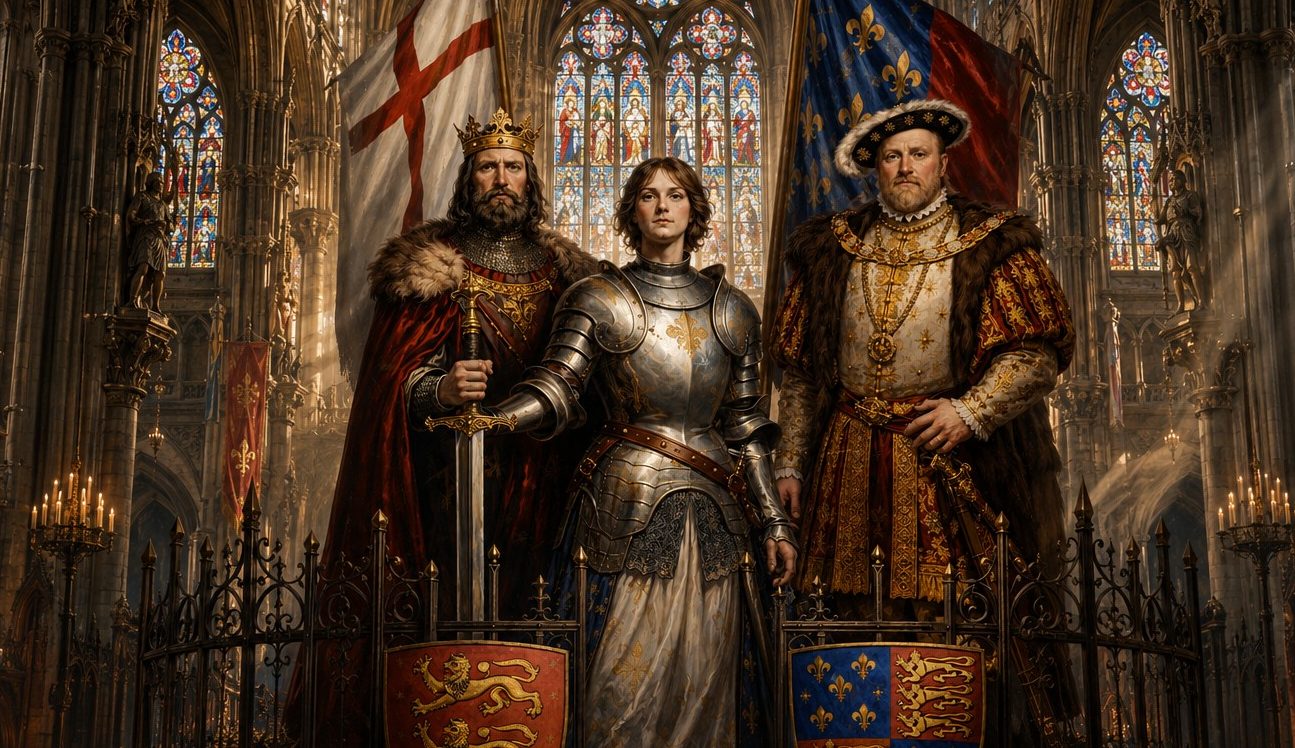

Standing at the heart of Rouen Cathedral, the Cathedral of Notre-Dame de Rouen is more than a church. It is a stone chronicle of Normandy itself — a monument that witnessed Viking descendants become French nobles, Norman dukes become kings of England, and the long struggle between England and France during the Hundred Years’ War.
Few cathedrals in Europe have stood at the crossroads of so much history.
Before the Gothic Cathedral
Christian worship had existed on the site since Roman times. Rouen was already an important city of Roman Gaul, known as Rotomagus, and by the fourth century possessed a bishop.
The earliest churches on the site were repeatedly damaged by war and fire. During the ninth century, Viking raids swept up the Seine Valley, devastating many ecclesiastical buildings.
Everything changed in 911 when the Viking leader Rollo entered into an agreement with the French king Charles the Simple. In exchange for defending the Seine from further Viking attacks, Rollo received lands around Rouen.
Rouen became the capital of the new Duchy of Normandy.
As the Viking settlers became Norman Christians, the cathedral became the spiritual centre of their new realm.
The Romanesque Cathedral of the Norman Dukes
The first great Norman cathedral arose during the eleventh century.
The Norman dukes were among the most powerful rulers in Europe, and Rouen reflected their ambition. Massive Romanesque towers, thick walls and rounded arches dominated the skyline.
The cathedral was closely associated with the Norman ducal house.
When William the Conqueror crossed the Channel in 1066, Rouen was effectively the capital of his continental possessions. The cathedral became one of the most important churches in the Anglo-Norman world, serving a realm that stretched from the Scottish border to the Pyrenees.
Merchants, pilgrims, bishops and nobles flowed through Rouen’s streets. Wealth from England and Normandy funded ever more ambitious building projects.
Yet the Romanesque cathedral would not remain.
The Birth of Gothic Rouen
In 1200 disaster struck.
A catastrophic fire swept through Rouen, destroying much of the existing cathedral.
Rather than rebuild in the old style, the church authorities embraced the revolutionary Gothic architecture emerging from the Île-de-France.
This was the age of Basilica of Saint-Denis and the ideas of Abbot Suger.
The new Gothic style sought height, light and spiritual wonder.
At Rouen the rebuilding began almost immediately.
The architects introduced:
- Pointed arches
- Ribbed vaults
- Flying buttresses
- Vast stained-glass windows
- Slender stone supports
These innovations allowed walls to become lighter and taller than ever before.
Visitors entering the cathedral suddenly found themselves surrounded by coloured light rather than enclosed by heavy stone.
Early Gothic to High Gothic
The thirteenth century saw Rouen transformed into one of the great Gothic cathedrals of Europe.
Unlike the relatively uniform construction of cathedrals such as Laon Cathedral, Rouen evolved over centuries. Each generation added new elements reflecting changing tastes and technology.
The choir and transepts demonstrated the elegance of the Early Gothic style.
As construction continued, newer sections adopted the more sophisticated High Gothic approach visible at places such as Chartres Cathedral and Reims Cathedral.
The cathedral became a living architectural textbook showing the evolution of Gothic design.
A City Between Two Crowns
Rouen occupied a unique position.
Although part of France geographically, Normandy remained deeply connected to England through the descendants of William the Conqueror.
For centuries the English kings also held vast territories in France.
This dual identity brought both prosperity and conflict.
The cathedral stood at the centre of this political tension.
Its bishops often found themselves navigating the competing interests of French kings and English monarchs.
Rouen and the Hundred Years’ War
When the Hundred Years’ War erupted, Normandy became one of the most contested regions in Europe.
Rouen’s strategic importance made it a prize worth fighting for.
The city suffered economic hardship and political uncertainty as armies marched across northern France.
Then came one of the defining moments in Rouen’s history.
In 1419, following the campaigns of Henry V, Rouen fell to the English after a lengthy siege.
The city became the administrative capital of English Normandy.
For the next three decades English banners flew over Rouen.
The cathedral remained active, but now under English occupation.
Joan of Arc and Rouen
No figure is more closely associated with Rouen than Joan of Arc.
Captured by Burgundian forces allied with England in 1430, Joan was eventually transferred to English custody.
She was brought to Rouen, where her trial for heresy took place.
Although much of the proceedings occurred in various buildings around the city, the cathedral played an important symbolic role in the drama.
Following her condemnation, Joan was burned at the stake in Rouen on 30 May 1431.
The execution occurred in the marketplace rather than at the cathedral itself, but Rouen forever became linked to her story.
Twenty-five years later, after France had recovered much of its territory, a retrial ordered by the Church declared Joan innocent.
The judgment helped transform her from condemned heretic into national heroine.
The End of English Normandy
The tide of war eventually turned.
French victories under Charles VII steadily dismantled English control.
In 1449 French forces re-entered Rouen.
The city welcomed the return of French rule.
Only four years later, the French victory at the Battle of Castillon effectively ended the Hundred Years’ War.
Normandy would never again be ruled by English kings.
Rouen Cathedral had witnessed the entire story:
- The rise of Viking Normandy.
- The age of William the Conqueror.
- The creation of the Anglo-Norman world.
- The flowering of Gothic architecture.
- English occupation.
- The martyrdom of Joan of Arc.
- The final triumph of France.
Legacy
Today Rouen Cathedral remains one of the greatest Gothic monuments in Europe.
Its soaring nave, intricate façades and magnificent towers represent more than architecture. They embody the story of Normandy itself — a land forged by Vikings, transformed by faith, contested by kings and ultimately absorbed into the French nation.
When standing beneath its vaults, one is not merely inside a church.
One is standing at the meeting point of England and France, of Romanesque and Gothic, of conquest and reconciliation — in a building that has witnessed nearly a thousand years of European history.